
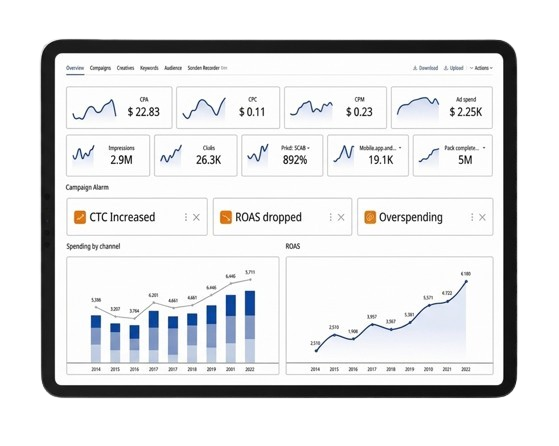
For enterprise businesses, SEO is more than a way to increase website traffic—it’s a powerful growth strategy that can strengthen your brand, expand market share, and create lasting customer relationships. A well-executed enterprise SEO strategy gives you greater control over your online visibility and brand presence while helping your business reach the right audiences at every stage of the customer journey. With scalable, evergreen content and data-driven optimisation, SEO can deliver sustainable long-term value while complementing your broader digital marketing efforts. At First Rank Online, we develop tailored enterprise SEO strategies designed around your business goals, target markets, and competitive landscape, helping you build authority, capture new opportunities, and establish a stronger global presence. Take control of your brand’s digital future with an enterprise SEO strategy built for sustainable growth.
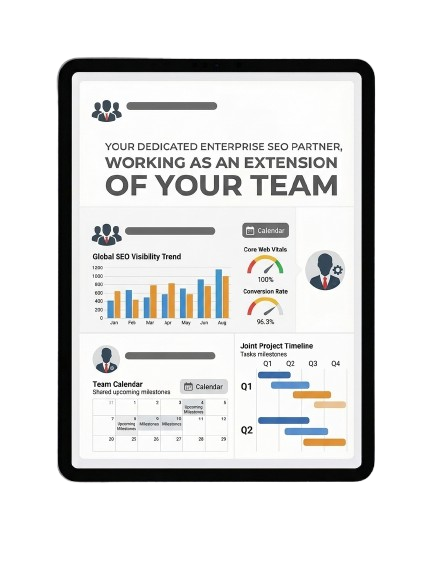
Enterprise SEO requires more than technical optimisation—it demands strategic thinking, meticulous planning, scalable processes, and a deep understanding of complex search landscapes. At First Rank Online, we work as an extension of your team, collaborating closely with your marketing and digital departments to develop and execute enterprise SEO strategies built around your business objectives. With more than 22 years of experience, our team has helped businesses strengthen their online presence, compete in highly competitive search markets, and unlock sustainable digital growth. We combine technical expertise, content strategy, data-driven insights, and continuous optimisation to help improve organic visibility, attract high-value traffic, reduce customer acquisition costs, and increase revenue. Partner with First Rank Online and gain an experienced enterprise SEO team focused on turning your search presence into a powerful engine for long-term growth.

“Firstrank Online has been an excellent Google Ads partner. Their team takes a strategic, data-driven approach to campaign management, continuously identifying opportunities to improve targeting, conversions, and overall performance. Their transparency, responsiveness, and focus on measurable results have made a significant difference. We highly recommend Firstrank Online for Google Ads management.”


“Firstrank Online has been an outstanding SEO partner. Their team combines a clear understanding of our business with a strategic, data-driven approach that has helped strengthen our online visibility and organic search performance. Their communication, transparency, and commitment to delivering measurable results have made working with them a great experience. We highly recommend Firstrank Online for SEO.”

“Firstrank Online has been an excellent partner for managing and strengthening our online reputation. Their team is proactive, professional, and highly responsive, with a clear focus on building trust and maintaining a positive brand presence. Their strategic approach to reputation management has made a real difference, and we highly recommend their services.”

“Firstrank Online has been a reliable digital marketing partner. Their team understands our goals, communicates clearly, and takes a strategic, results-focused approach to every campaign. We’ve been impressed with their professionalism, transparency, and commitment to delivering measurable growth.”
“FirstRank Online has been instrumental in strengthening our online presence through their SEO expertise. Their strategic approach, attention to detail, and consistent optimisation helped improve our search visibility and attract more relevant traffic to our website. The team was professional, responsive, and focused on delivering results that aligned with our business goals. We highly recommend FirstRank Online to any business looking to grow through effective SEO.”

Dominate Your Local Market with SEO That Drives Brand Awareness, Foot Traffic and Sales.
LEARN MORE
Grow Your Ecommerce Business with SEO That Drives More Traffic, Builds Brand Authority, and Turns Searchers into Loyal Customers.
LEARN MORE
Go Global with International SEO That Expands Your Reach, Builds Brand Authority and Drives Loyal Customers
LEARN MORE
Build High-Quality Backlinks, Strengthen Your Authority, and Boost Your Google Search Rankings.
LEARN MORE
Enterprise SEO is the strategic optimization of large, complex websites with thousands or millions of pages, multiple business units, brands, locations, or international markets. Unlike smaller-scale SEO, Enterprise SEO requires scalable technical solutions, sophisticated site architecture management, large-scale content optimization, advanced analytics, cross-functional collaboration, and governance processes that can operate across an entire organization.
We provide comprehensive Enterprise SEO services tailored to large-scale websites and complex organizations. Our services can include technical SEO, enterprise keyword research, large-scale content optimization, international SEO, programmatic SEO, website migrations, crawl and indexation optimization, enterprise link building and digital PR, multi-location SEO, SEO analytics, competitor analysis, and ongoing performance reporting.
We build the strategy around your website architecture, business objectives, technology stack, markets, and organizational structure rather than applying a standard SEO package.
We begin by understanding your business structure, website architecture, technology stack, target markets, products or services, competitors, and commercial objectives. We then conduct a comprehensive technical and search-performance assessment to identify opportunities, risks, and priorities.
From there, we create a scalable SEO roadmap that establishes strategic priorities, technical requirements, content opportunities, implementation timelines, KPIs, ownership, and measurement frameworks. This allows SEO initiatives to align with both search performance and broader business goals.
Large websites require scalable systems rather than page-by-page optimization. We analyze site architecture, URL structures, internal linking, crawlability, indexation, templates, faceted navigation, pagination, duplicate content, XML sitemaps, and other large-scale technical factors.
Where appropriate, we use automation, templates, data analysis, and programmatic processes to identify and resolve issues across large numbers of URLs while maintaining appropriate quality controls.
Our Enterprise Technical SEO process can cover crawlability, indexation, JavaScript rendering, site architecture, internal linking, canonicalization, redirects, structured data, XML sitemaps, Core Web Vitals, internationalization, URL parameters, duplicate content, log-file analysis, and large-scale technical errors.
We prioritize issues according to their potential impact on organic visibility, user experience, and business performance and provide implementation-ready recommendations for development and IT teams.
We operate as an extension of your internal teams rather than working in isolation. We can collaborate with developers, product managers, content teams, IT, analytics teams, and marketing stakeholders through established workflows and project-management systems.
Our recommendations can be translated into clear technical requirements, implementation tickets, priorities, acceptance criteria, and validation processes so SEO becomes part of your organization's existing development and marketing workflow.
We treat enterprise migrations as a structured SEO project before, during, and after launch. Our process can include URL mapping, redirect planning, metadata preservation, canonicalization checks, XML sitemap validation, staging-site audits, crawl testing, analytics verification, indexation monitoring, and post-launch diagnostics.
We establish a migration checklist and monitoring framework designed to identify SEO issues quickly and minimize unnecessary disruption to organic visibility and revenue.
We develop international SEO strategies based on your target countries, languages, business structure, website architecture, and regional search behavior. Depending on the situation, this can include hreflang implementation and validation, international keyword research, localized content, country or language architecture, regional URL strategies, international technical SEO, and market-specific search analysis.
The objective is to help search engines understand which version of your content is appropriate for users in each market while ensuring each regional experience genuinely serves its audience.
Programmatic SEO can create significant opportunities when a business has large amounts of structured data and genuine search demand across many page types. We develop scalable templates and rules for elements such as titles, headings, metadata, internal links, and content components while establishing quality controls.
We also evaluate indexation, duplication, search intent, thin content, cannibalization, and low-value URL generation to ensure scale does not compromise the quality of the website.
Enterprise keyword research combines large-scale search data with business priorities, search intent, competition, and market opportunity. We segment keywords by product or service, business unit, customer journey, geography, brand versus non-brand, and informational versus commercial intent.
This allows us to create keyword and topic frameworks that can be mapped across thousands of pages while identifying the opportunities with the greatest potential business value.
We identify content gaps, underperforming pages, duplicate or overlapping content, search-intent mismatches, and opportunities across product, category, service, editorial, and resource sections.
We then establish scalable content frameworks, optimization guidelines, templates, internal linking strategies, and governance processes. Where content is generated or optimized at scale, we maintain appropriate quality controls so the content remains useful, accurate, relevant, and aligned with user intent.
We first identify whether crawl and indexation efficiency is actually limiting performance. For large websites, we analyze crawl patterns, server responses, URL parameters, faceted navigation, duplicate URLs, internal linking, XML sitemaps, redirects, canonical signals, and low-value pages.
We then prioritize changes that help search engines discover and process important content efficiently while reducing unnecessary crawling of URLs that do not need to be indexed.
We establish a governance and architecture strategy that considers each brand's audience, positioning, website structure, search demand, and business objectives. We assess opportunities for keyword overlap, content duplication, cannibalization, internal linking, domain architecture, and shared search opportunities.
The goal is to maximize the collective organic opportunity while maintaining clear differentiation between individual brands and websites.
Yes. We support businesses managing large numbers of locations, franchises, offices, stores, or service areas. Depending on the organization's structure, our work can include multi-location landing pages, Google Business Profile management processes, local keyword research, location data management, local content, citation consistency, review strategies, and scalable local SEO governance.
We build centralized processes that allow local optimization to operate efficiently across hundreds or thousands of locations.
We develop link acquisition and digital PR strategies around the scale, reputation, expertise, and resources of the enterprise brand. Campaigns can include digital PR, original research, data-driven content, expert commentary, newsworthy campaigns, industry resources, and targeted editorial outreach.
We focus on earning relevant editorial coverage and links from credible publications rather than relying on bulk or low-quality link placements.
We establish KPIs around your organization's actual commercial objectives rather than relying exclusively on rankings or traffic. Depending on your business model, we can measure organic revenue, qualified leads, conversions, non-brand visibility, organic traffic, market share, product or category performance, customer acquisition, and other relevant business metrics.
Where reliable data is available, we connect SEO performance with analytics and CRM data to provide a clearer view of its contribution to revenue and pipeline.
Yes. Enterprise organizations often have different reporting requirements across executives, marketing teams, product teams, developers, and regional managers.
We can structure reporting around each stakeholder's needs, from executive-level business KPIs and organic revenue to detailed technical SEO, content, keyword, and market-level performance. This makes SEO performance easier to understand and helps teams make informed decisions.
Enterprise SEO often requires cooperation across multiple departments. We help establish clear processes for SEO ownership, technical requirements, content standards, prioritization, approvals, implementation, QA, and performance measurement.
We also translate SEO recommendations into business terms—such as potential traffic, revenue opportunity, implementation effort, and risk—so decision-makers can understand why an initiative matters and allocate resources accordingly.
The timeline depends on the website's size, technical condition, competitive environment, authority, implementation speed, target markets, and the scale of the recommended changes. Some technical improvements can produce relatively early movement, while broader gains in organic visibility, traffic, and revenue generally require sustained execution.
For enterprise organizations, we establish short-, medium-, and long-term milestones so progress can be evaluated throughout the engagement rather than waiting for a single end-point result.
We begin with a strategic discovery process to understand your organization, website ecosystem, technology stack, target markets, competitors, current SEO performance, and business objectives.
We then conduct the appropriate enterprise-level analysis, identify the highest-priority opportunities and risks, and develop a customized roadmap with recommended initiatives, resources, timelines, and KPIs. Once the strategy is approved, we work with your internal teams to establish implementation workflows and begin execution.